The short version: 269 × 300s frames through an Optolong L-Quad, 22h 25m of integration, processed in PixInsight. Forced crop due to sensor contamination, but the result is the best M51 I’ve produced.
I’ve imaged M51 before, but never like this. Three nights across a week — 3/22, 3/24, and 3/26 — and roughly four times the integration I’d previously collected on this galaxy. The jump in data shows. Detail in the spiral arms and the interaction with NGC 5195 came through in a way earlier sessions never delivered.
The session on 3/23 was a wash. A power outage mid-night killed the run entirely, so that data never made it to the stack. What I did collect across the three usable nights was 269 frames at 300 seconds each — no rejection, because I manually review and prune anything that misses the mark before it ever hits WBPP.
Acquisition
Shot with the Askar 120 and .8x reducer, ZWO ASI2600MC Pro, on the ZWO AM5. Unity gain on the 2600MC. Filter was the Optolong L-Quad Enhance — a good choice for a Bortle 5 backyard where light pollution is always a factor, even on galaxy targets.
300-second subs at this focal length gave enough signal per frame without pushing into saturation on the core. 88 frames on the 22nd, 91 on the 24th, 90 on the 26th — 269 total, all kept.
Processing
Full workflow in PixInsight:
- WBPP — integrated lights with flats and bias. 2x drizzle applied to preserve detail at this focal length.
- SPCC — spectrophotometric color calibration before any stretching.
- Crop — large artifacts on both sides of the frame from sensor contamination forced a significant crop, bringing the final image down to 6200×6200. More on this below.
- GraXpert — gradient removal before stretching.
- BlurXTerminator — sharpening pass on the integrated data.
- NoiseXTerminator — noise reduction.
- GHS — Generalized Hyperbolic Stretch to bring out the galaxy while keeping the background controlled.
- StarXTerminator — stars separated from the galaxy for independent processing.
- LocalHistogramEqualization — applied to the galaxy layer to pull out structure in the arms.
- RangeSelection mask — isolated the galaxy for targeted saturation and luminance adjustments in Curves.
- MorphologicalTransformation — reduced star size on the star layer, which runs large at the Askar 120’s focal length.
- PixelMath recombination —
galaxy + stars - galaxy * starsto merge the layers cleanly.
Exported as XISF and TIFF. The TIFF was converted to WebP for the site using ImageMagick.
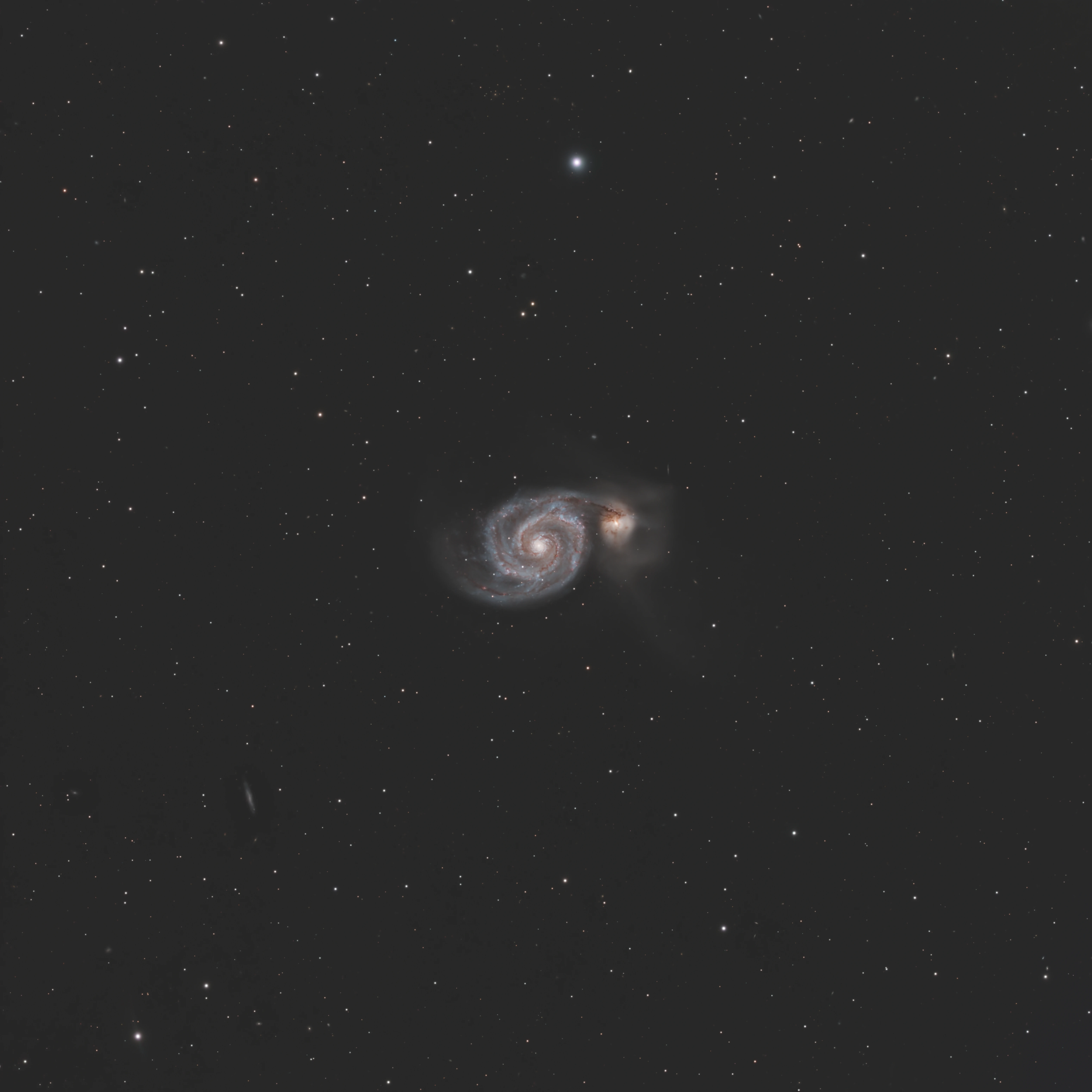
What I’d Do Differently
Clean the image train first. The artifacts that forced the crop came from contamination on the UVIR cut filter sitting in front of the sensor — something I knew needed attention and didn’t get to before these sessions started. The crop cost me a complete frame and some real estate I won’t get back on this run. A sensor cleaning kit is already ordered.
Beyond that, processing on this image is still evolving. The techniques I used here — particularly the LHE pass on the galaxy and the star/galaxy separation workflow — are newer to my process, and I’ll keep refining the result. But even with the forced crop, this is the best M51 I’ve made, and the data is there to keep working with.